
Side Out vs. Rally Scoring: What the Debate Actually Means for Rec Players
If you have heard people talking about side out vs rally scoring lately and wondered whether pickleball scoring is changing under your feet, you are not alone. A lot of rec players are hearing the phrase “rally scoring” during tournament broadcasts, in league conversations, or from that one guy at open play who watches every pro match and brings a full rules briefing to Court 3.
The short version is this: side-out scoring is still the system most recreational players use, but rally scoring is becoming more common in certain pro, tournament, and experimental formats. The debate matters because the two systems change how points are earned, how momentum feels, and how the game is watched.
What Side-Out Scoring Actually Is
What is traditional pickleball scoring?
Traditional pickleball scoring is side-out scoring. That means only the serving team can score a point.
If your team is serving and wins the rally, you get a point. If your team is receiving and wins the rally, you do not get a point. Instead, you earn the serve back, or move the serve to the next server depending on where you are in the rotation.
That is why doubles pickleball uses three numbers when the score is called. For example:
4–2–1
That means:
The serving team has 4.
The receiving team has 2.
The serving team is on server 1.
If that same team loses the rally, the serve moves to server 2. If server 2 loses the rally, that is a side out, and the other team gets the serve.
Most open play, rec games, club ladders, and casual matches still use this format. USA Pickleball’s rules page describes traditional side-out scoring as points being scored only by the serving team, with games normally played to 11 and won by 2.
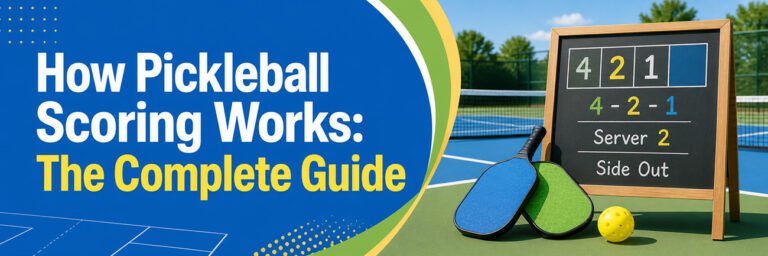
For a full breakdown of the normal scoring pattern, start with How Pickleball Scoring Works: The Complete Guide. This post is more focused on the debate between systems than on teaching every scoring rule from scratch.
What Rally Scoring Actually Is
What is rally scoring in pickleball?
Rally scoring means every rally produces a point.
It does not matter who served. If you win the rally, your team gets a point. If you lose the rally, the other team gets a point.
That is the biggest difference.
In rally scoring pickleball, the score usually moves faster because points are awarded on every rally. Depending on the format, games may be played to 21, 15, or another target score, typically with a win-by-2 requirement. USA Pickleball’s 2026 rule change document describes rally scoring as a format where a point is scored by the singles player or doubles team that wins each rally, while tournament directors have the option to use rally scoring in certain settings.
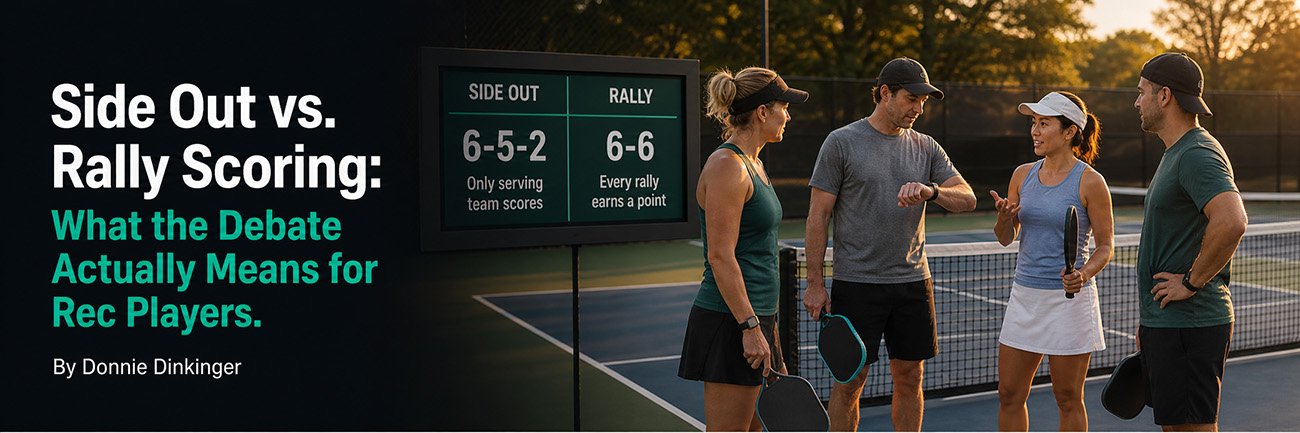
Rally scoring also usually removes the third number from the score call. Instead of calling something like 6–4–2, you are usually just calling the two team scores.
So instead of:
6–4–2
You would hear:
6–4
That alone makes rally scoring feel simpler to some newer players. There is no server-one/server-two call to track in the same way. But simpler score calls do not automatically mean the game feels the same.
That is where the debate starts.
Side Out vs Rally Scoring: The Same Rally, Two Different Outcomes
The easiest way to understand side out vs rally scoring is to look at the same point under both systems.
Let’s say Team A is serving to Team B. The score is 6–5.
If the serving team wins the rally
Under side-out scoring, Team A earns a point because Team A was serving. The score becomes 7–5. The serving team keeps serving, and the server may switch sides depending on the score and format.
Under rally scoring, Team A also earns a point. The score becomes 7–5. Same result.
This is the part that feels familiar. When the serving team wins the rally, both systems usually reward that team with a point.
If the receiving team wins the rally
This is where the systems split.
Under side-out scoring, Team B does not earn a point because Team B was receiving. Instead, Team A loses the serve. Depending on whether Team A was on server 1 or server 2, the serve either moves to the second server or goes over to Team B.
The score may stay 6–5.
Under rally scoring, Team B wins the rally and earns a point immediately. The score becomes 6–6. Team B also gets the serve.
That is the cleanest way to think about it:
In side-out scoring, winning a rally while receiving earns you the opportunity to score.
In rally scoring, winning a rally while receiving earns you the point right away.
That one difference changes the rhythm of the game.
The Case for Rally Scoring
The strongest argument for rally scoring is pace.
Because every rally creates a point, games tend to move more predictably. That matters in settings where timing is important. Pro broadcasts, tournament courts, league schedules, and crowded facilities all benefit from knowing that games are less likely to stretch unpredictably.
For a casual viewer, rally scoring can also be easier to follow. Every rally matters on the scoreboard. You do not need to explain why a team won a rally but did not get a point. If someone wins the rally, the score changes. That feels intuitive.
Rally scoring can also make the score call simpler. Without the third number in doubles, there is less for newer players to decode. A score like 9–8 is easier to understand than 9–8–2 if you are still learning how serving rotations work.
Supporters also argue that rally scoring adds urgency. Since every rally moves the score, there are fewer “empty” rallies from a scoring perspective. A great defensive stand by the receiving team does not just win the serve back. It shows up on the scoreboard immediately.
That can make matches feel tighter, faster, and more viewer-friendly.
Those are legitimate points. For formats that need predictable match length or better broadcast flow, rally scoring solves real problems.
The Case for Traditional Side-Out Scoring
The strongest argument for traditional pickleball scoring is that it protects the strategic value of the serve.
In side-out scoring, earning the serve back matters. You do not just win a point by winning a receiving rally. You win the right to go score. That creates a different kind of momentum.
A team can defend, survive, earn the ball back, and then build a run. That pattern is a major part of how many players understand pickleball. It rewards patience. It gives teams time to recover. It makes scoring feel earned over a longer sequence, not just one rally at a time.
Traditional side-out scoring also creates tension around serve rotation. Server 1 and server 2 matter. A team may get one chance or two chances to score before giving the ball back. That adds structure and strategy, especially in doubles.
Many rec players also feel that side-out scoring is simply the normal version of pickleball. It is what they learned. It is what their group plays. It is what most clubs use. To those players, rally scoring may feel like it removes part of the sport’s identity.
That does not mean rally scoring is wrong. It just means the objection is not only about arithmetic.
It is about feel.
Side-out scoring can make a game feel more patient, more layered, and more connected to the way pickleball has traditionally been played.
Where Rec Players Will Actually See Rally Scoring
For most rec players, traditional side-out scoring is still the default.
If you show up to open play, a neighborhood court, a round robin, or a casual club ladder, odds are you are still playing side-out scoring. You will still hear three numbers in doubles. You will still only score when serving. You will still need to track server 1 and server 2.
Rally scoring is more likely to show up in specific contexts: pro broadcasts, certain league formats, some tournament experiments, and tiebreaker-style formats. Major League Pickleball’s 2026 competition updates, for example, describe DreamBreaker lineups as part of match structure, while MLP rules materials have used rally scoring for DreamBreaker formats even as doubles formats have shifted by season.
The practical takeaway is simple: you probably do not need to change how you play your weekly games unless your league, tournament director, or club tells you they are using rally scoring.
But it is worth understanding the difference.
That way, if someone says, “We’re playing rally scoring to 21,” you are not learning the format after the first argument.
What the Debate Is Really About
The debate over pickleball scoring changes is not really about whether players can count.
Both systems are easy enough once you understand the pattern. The disagreement is about what kind of game people want pickleball to be.
Rally scoring points the sport toward faster games, simpler viewing, and more predictable match lengths. That is useful for broadcasts, organized events, and settings where court time has to be managed tightly.
Side-out scoring protects more of the traditional rhythm. It keeps the serve central. It allows momentum to build through earning the serve back, not just through adding points. It makes the game feel a little more patient.
Neither side is crazy.
They are just valuing different things.
If your main concern is clean scheduling and easy viewing, rally scoring makes sense. If your main concern is preserving the strategy and rhythm of rec doubles, traditional side-out scoring makes sense too.
That is why this debate keeps coming back. It is not settled because the sport is serving different audiences at the same time.
How to Keep Score Either Way
Here is the part that does not change: whether you are playing side-out scoring or rally scoring, someone still has to keep the score during live play.
That is usually where the trouble starts.
Side-out scoring asks you to remember the score, the server number, the side, and the serving sequence. Rally scoring removes some of that, but it does not remove the basic problem of tracking points while you are also trying to play the next ball.
You still have to return serve. You still have to move your feet. You still have to communicate with your partner. You still have to remember whether that last rally made it 12–10 or 13–10.
This is where a simple score tracker helps. PickleScore was built for the part of the game that gets messy in real life: keeping the score visible without pulling your attention off the court. At the score level, it works whether your game is using traditional side-out scoring or rally scoring. You still need to know the format you are playing, but you do not have to carry the score in your head between every rally.
If you are comparing tools, you can also read PickleScore vs. Other Pickleball Scoring Apps for a broader look at why simplicity matters during actual play.
The best scoring system is the one your game is using that day. The best habit is making sure everyone on the court knows the score before the next serve.
And if you would rather keep that score on your wrist instead of reconstructing it two points later, PickleScore was built for exactly that.