
How Pickleball Scoring Works: The Complete Guide
If you are new to pickleball, scoring can seem more confusing than the game itself. Between the points, the serve, and in doubles, the server number, there is more to keep track of than many first-time players expect.
The good news is that pickleball scoring is not actually complicated once you understand the pattern. Whether you are playing rec games, open play, or more competitive matches, learning how pickleball scoring works will help you stay more confident on court and avoid the constant, “What’s the score?” moment.
In this complete guide, we will break down pickleball scoring rules in plain English, including how scoring works in doubles, how scoring works in singles, what a side-out means, and the most common mistakes players make.
The Basic Rule of Pickleball Scoring
The most important rule to understand is this:
In traditional pickleball scoring, only the serving side can score a point.
If the serving side wins the rally, they earn a point and continue serving. If the receiving side wins the rally, they do not score a point. Instead, the serve either moves to the other partner in doubles or goes to the other player in singles.
That is the foundation of standard pickleball scoring and the main reason new players get confused. Not every rally results in a point. In most games, only the serving side can add to the score.
Most pickleball games are played to 11 points, and a team or player must win by 2. In some formats, games may be played to 15 or 21, but the scoring structure works the same way.
Why Pickleball Scoring Feels Confusing at First
Pickleball scoring feels unusual because players are not just calling out the score. They are also communicating who is serving.
In singles, the score is called with two numbers:
- the server’s score
- the receiver’s score
In doubles, the score is called with three numbers:
- the serving team’s score
- the receiving team’s score
- the server number
That third number is what makes doubles scoring feel harder at first. But once you understand what it means, the system becomes much easier to follow.
How Pickleball Scoring Works in Doubles
Doubles is the most common pickleball format, and it is where most players need the most help.
The Three-Number Score
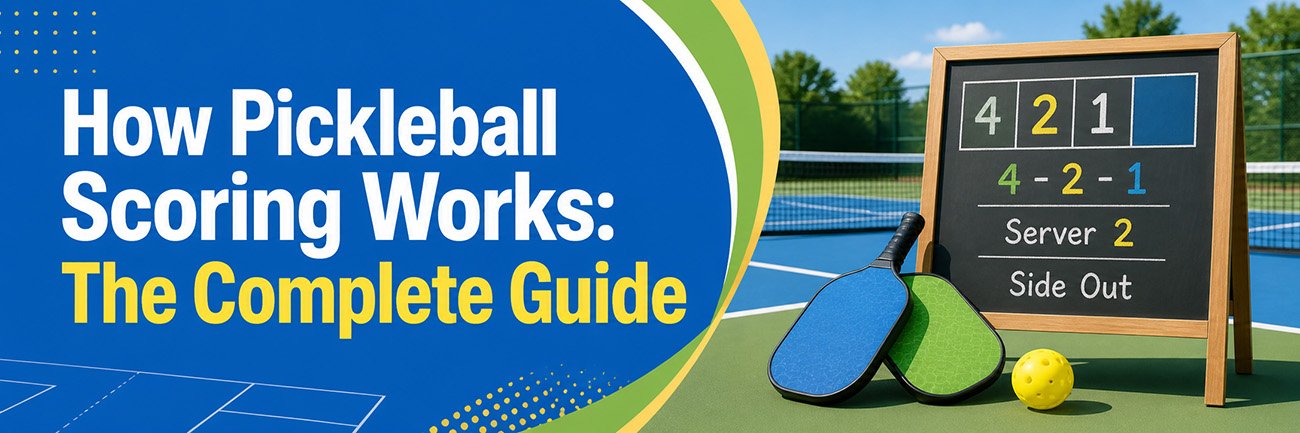
In doubles, the score is announced with three numbers.
For example:
4-2-1
This means:
- the serving team has 4 points
- the receiving team has 2 points
- the current server is the first server on that team
If the score is called:
4-2-2
It means the serving team still has 4, the receiving team has 2, and now the second server is serving.
That third number is there to tell everyone whether the serving team is on its first server or second server during that turn.
How the Game Starts
At the start of a doubles game, the opening score is called:
0-0-2
This is one of the quirks of pickleball scoring that surprises a lot of beginners.
The team that serves first in the game only gets one server before the ball goes to the other team. After that opening sequence, each team gets two servers per turn, one for each player, before a side-out.
So while the score starts at 0-0-2, that opening team is not actually using a normal two-server sequence yet. It is a special case that only applies at the start of the game.
What Happens When the Serving Team Wins a Rally
When the serving team wins a rally in doubles:
- they score a point
- the same server keeps serving
- the two partners switch sides
This continues until that server loses a rally.
What Happens When the Server Loses a Rally
If the first server loses a rally:
- no point is scored
- the serve moves to that player’s partner
- the server number changes from 1 to 2
If the second server loses a rally:
- no point is scored
- the team loses the serve
- it becomes a side-out
The ball then goes to the other team, and they begin their serving turn.
A Simple Example of Doubles Scoring
Here is the easiest way to see the pattern.
Team A starts the game. The opening call is:
0-0-2
Team A wins the first rally. The score becomes:
1-0-2
The same server continues, but now serves from the opposite side.
If Team A then loses the rally, their opening service turn is over and the serve passes to Team B.
Team B starts with:
0-1-1
If Team B wins the rally, the score becomes:
1-1-1
If Team B loses the next rally, the serve moves to their partner:
1-1-2
If that second server loses the rally, it is a side-out back to Team A.
Once you understand that rhythm, doubles scoring starts to make sense:
- only the serving team can score
- first server loses rally, partner serves
- second server loses rally, side-out
That is the pattern players are really trying to follow during a game.
How Player Position Connects to the Score in Doubles
Another important part of pickleball doubles scoring is player position.
A simple way to remember it is this:
When a team’s score is even, the player who started on the right side will be on the right side. When the team’s score is odd, that player will be on the left side.
This helps players recover when they lose track of positioning. If you know your team’s score and you know who started on the right, you can usually work out where everyone should be standing.
This is especially useful in rec play, where players often lose track of both the score and who should be serving or receiving.
How Pickleball Scoring Works in Singles
Singles scoring is much simpler than doubles.
In singles, the score is called with two numbers:
- the server’s score
- the receiver’s score
For example:
5-3
That means the server has 5 points and the receiver has 3 points.
The Even and Odd Rule in Singles
In singles, your score tells you which side you serve from.
- If your score is even, you serve from the right side
- If your score is odd, you serve from the left side
So if your score is 0, 2, 4, 6, 8, or 10, you serve from the right. If your score is 1, 3, 5, 7, or 9, you serve from the left.
That even-and-odd rule is one of the easiest ways to keep singles scoring straight.
Just like doubles, only the serving player can score in traditional pickleball scoring. If the receiver wins the rally, they gain the serve, but they do not get a point.
What Is a Side-Out in Pickleball?
A side-out is when the serve changes from one side to the other.
In singles, a side-out happens whenever the server loses the rally.
In doubles, a side-out happens after both servers on a team have lost their rallies, except for the special opening sequence where the first team only gets one server.
A side-out does not mean a point was scored. It simply means the other side now has the opportunity to serve and try to score.
This is one of the most misunderstood parts of pickleball scoring. Players often assume that winning a rally automatically means winning a point. In traditional scoring, that is only true if you were already serving.
Common Pickleball Scoring Mistakes Beginners Make
1. Thinking every rally results in a point
This is the most common mistake. In traditional pickleball scoring, only the serving side can score.
2. Forgetting the third number in doubles
That third number matters. It tells everyone whether the current server is the first server or second server for that team’s turn.
3. Mixing up the opening score
Many beginners assume doubles games start at 0-0-1, but the correct opening call is 0-0-2.
4. Losing track of positions
In doubles, player position is tied to the score. If you forget where you should be, use the even-or-odd score rule to help reorient the court.
5. Forgetting to call the score before serving
Calling the score before the serve helps all four players stay aligned and reduces disputes during the game.
The Best Way to Remember Pickleball Scoring
If you are trying to simplify the whole system, remember these rules:
In doubles:
- call three numbers
- only the serving team scores
- first server loses rally, second server serves
- second server loses rally, side-out
In singles:
- call two numbers
- only the server scores
- even score serves from the right
- odd score serves from the left
That is the core of how pickleball scoring works.
Why Players Still Lose the Score
Even after learning the rules, it is still easy to lose track in real games.
Pickleball moves fast. There are long rallies, side switches, partner communication, momentum swings, and plenty of distractions. In rec play, open play, or competitive doubles, it is common for players to forget the score even when they know the rules.
That is not because pickleball scoring is broken. It is because remembering the score in the middle of live play is harder than it sounds.
Final Takeaway
Pickleball scoring is much easier once you stop thinking of it as random numbers and start seeing it as a pattern.
Here is the pattern:
- only the serving side can score
- doubles uses three numbers
- singles uses two numbers
- doubles usually gives each team two servers per turn
- singles servers serve from the right on even scores and the left on odd scores
- a side-out changes the serve, not necessarily the score
Once that clicks, the game gets much easier to follow.
Never Worry About the Score Again
Knowing the rules is one thing. Keeping the score straight during a real match is another.
That is exactly why PickleScore exists.
PickleScore keeps your pickleball score and serve tracking right on your Apple Watch, so you can focus on playing instead of trying to remember every point, server change, and side-out. No second-guessing. No arguments. No stopping play to reconstruct the score from three rallies ago.