
The Score Was Always Wrong. So I Built Picklescore: a Pickleball App
Picklescore: The point where nobody knew anything
We were on a public court in the middle of a normal rec game. Close score. Everyone sweating. Nobody playing badly enough to blame the chaos on that.
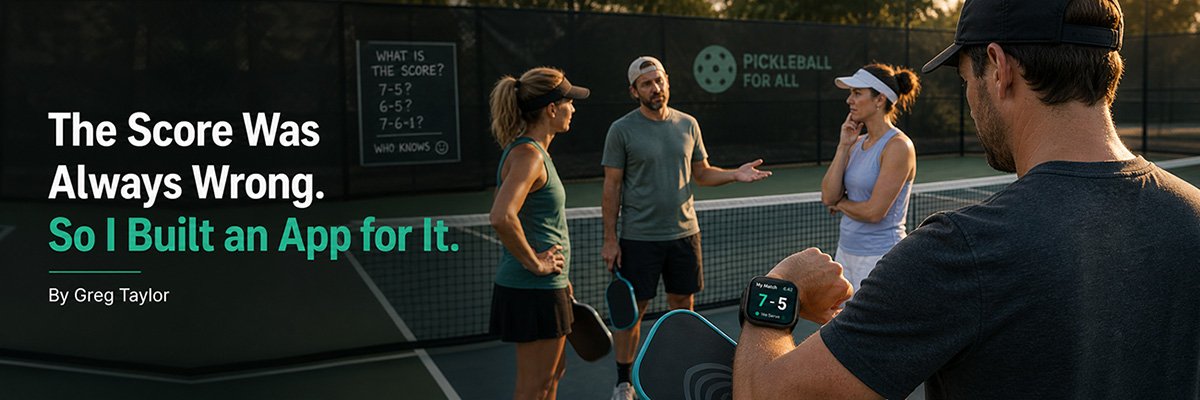
My partner and I had just finished a decent rally. A few drops. A reset or two. Somebody sped up a ball they probably shouldn’t have. Somebody else survived it. Then we got ready for the next point, and I called the score.
Someone across the net said, “No, I think it’s 6–4.”
My partner looked at me and said, “Wait, didn’t we have five?”
Then the fourth player, who had been confident about everything thirty seconds earlier, said, “No, no, I’m pretty sure it’s 5–5–2.”
And that was it. The game stopped.
Four adults stood on a pickleball court trying to reconstruct the last six points from memory. Who served after the side out? Did we win two in a row or only one? Was that the point where the drop hit the tape? Was I on the right or the left?
The worst part was not that nobody knew. The worst part was that everybody kind of knew. Just enough to be confident. Not enough to be right.
Why this kept happening
That would have been easier to ignore if it only happened once. It did not.
It happened in open play. It happened in rec games. It happened with beginners. It happened with stronger players. It happened when the game was casual, and it happened when the game got a little tighter and everyone suddenly cared more than they said they did.
The strange thing about pickleball scoring is that it makes sense when you explain it slowly. Server one. Server two. Side out. Start on the even side. Call three numbers. Nothing about it is impossible.
Then you actually play.
Now you are thinking about your return, your third shot, your partner’s position, whether that dink was too high, whether the person across from you is baiting you into a bad speedup, and whether your foot is drifting into the kitchen.
Somewhere in the middle of all that, you are also supposed to keep a tiny scoreboard running in your head.
That is the part people do not talk about enough. Pickleball scoring is not hard in isolation. It is hard during live play.
The tools that didn’t fit
Before I built anything, I tried the normal things.
I tried calling the score louder and more clearly every point. That helps until someone misses it, hears it wrong, or is walking back to receive.
I tried using my phone. That lasted about as long as you would expect. Your phone is in your bag, on the bench, under a towel, or just far enough away that checking it between points feels ridiculous.
I tried notes. I tried mental tricks. I tried being the person who “just remembers.” That person is usually wrong with more confidence.
I also looked at scoring apps. Some were fine in theory, but too many felt like they were built for someone managing a match from the sideline, not someone playing one. Too many taps. Too many screens. Too much stuff around the one thing I actually needed.
The problem was small. The tools felt big.
“I’ll just build it myself”
At some point, I said the sentence that usually gets people into trouble.
“I’ll just build it myself.”
In my head, it was going to be simple. A little Apple Watch app. Add a point. Subtract a point. Keep the score visible. Done.
That is a very comfortable lie developers tell themselves at the beginning of a project.
Because once you start building, the small decisions show up. Where should the buttons go? How big is big enough when someone is sweaty and rushing? What happens if you tap the wrong side? What happens if the app closes? What happens if you do not want to think about the app at all?
The first version was not about being clever. It was about removing friction. The court is very good at telling the truth. If something takes too long, you notice. If something is confusing, you notice. If you notice the app too much, the app is failing.
The things I left out
This became the most important part of PickleScore. Not what went in. What stayed out.
I thought about voice announcements. It sounded useful until I pictured four courts lined up next to each other, balls popping, people talking, and my wrist suddenly announcing a score into the chaos.
I thought about match history. I like data. I like knowing how I played. But during the game, match history does not help me know whether it is 7–5 or 6–6.
I thought about social profiles, sharing, player pages, league management, brackets, and all the other things that make an app feel bigger.
Some of those ideas are useful. They just were not the thing.
PickleScore became better every time I removed something that did not belong between points. The app I wanted on my wrist had one job: help me keep the score without pulling me out of the game.
No clutter. No maze of screens. No pretending the app needed to be bigger than the problem.
Simple is not something to apologize for. Simple is the point.
Why the watch made sense
The Apple Watch decision was not really about technology. It was about location.
The phone is in your bag. The watch is on you.
Pickleball happens in small windows. The rally ends. Someone grabs a ball. Someone walks back to serve. You have a few seconds before the next point starts.
That is not the time to unlock a phone. But it is enough time to tap your wrist.
The app had to live where the player already was. Not on the sideline. Not in a pocket. Right there.
One tap between rallies. Score updated. Keep playing.
The first game where I forgot about it
The best moment was not the first time the app worked. The best moment was the first time I stopped thinking about it.
I remember playing a game and realizing the usual score anxiety was gone. Nobody was pausing to negotiate the past. Nobody was trying to remember who served three points ago. Nobody was saying, “Are you sure?” with that tone that means they are absolutely not sure either.
The score was just there.
I would tap after a point and move on.
It did not make me play perfect pickleball. Nothing does. I still missed shots. I still made bad decisions. I still sped up balls that deserved a calmer life.
But I was not losing track of the score while doing it.
That mattered more than I expected. Score confusion does not just interrupt the game. It changes the mood of the game. A close rec game can go from fun to weird in about fifteen seconds when nobody agrees.
PickleScore did not make the game more serious. It made it lighter.
That is what I wanted.
If this has happened to you
I built PickleScore because I got tired of standing on a court with three other people, all of us holding paddles, all of us reasonably intelligent, none of us able to agree on the score of a game we were currently playing.
That still makes me laugh. It also still annoys me.
So the app stayed small on purpose. It lives on the wrist. It keeps the score visible. It gets out of the way.
If you have ever lost the score mid-game, argued through a side out, or watched four adults recreate six points from memory like a crime scene, this was built for you.